


Week of June 29, 2026
Published every Monday: Get a detailed snapshot of what moved the markets last week—and what to watch this week.
What the 2000 market can teach investors today.
A technology sell-off centered on stocks tied to AI enthusiasm led to a mixed week for equities. Other areas of the market gained ground, with the Russell 2000 Index up 1 percent and the equal-weight S&P 500 outperforming the market-weighted index by 200 basis points (bps). Bond markets were broadly higher.
Weekly Quick Hits
BEYOND THE HEADLINES:
What the 2000 market can teach investors today.
It’s been said that history doesn’t repeat itself, but it often rhymes. Consider a new technology that seems to be a game changer, stretched valuations for companies benefiting from that technology, and excitement about initial public offerings (IPOs) tied to that trend.
Although that may sound like today’s AI environment, it also describes what was happening in 1999 and early 2000. Today’s AI companies generally have more sustainable business models than their dot-com bubble counterparts, but echoes of 2000 are appearing below the surface of the stock market. Those similarities could offer useful insights for portfolio construction.
A Trip Down Memory Lane
Most investors remember the nearly 40 percent decline in the Nasdaq Composite in 2000 as the end of the internet boom. Although the Nasdaq was the worst-performing large-cap index, it reflected a violent rotation out of growth stocks. According to the Callan Periodic Table of Investment Returns, the S&P 500 Growth and Russell 2000 Growth indices each declined 20 percent.
The rest of the market, however, was composed of companies that weren’t direct beneficiaries of the internet and were trading at relatively attractive valuations. Those businesses also had established models that tended to produce earnings and cash flow. The Russell 2000 Value Index rallied more than 20 percent, and the S&P 500 Value Index rose 6 percent that year. Bonds also posted double-digit returns.
Even in one of the toughest market environments, there were ways to add value to portfolios. There usually are.
Today’s Market Environment
We aren’t experiencing the same environment today. AI companies have good business models—and AI adoption is happening faster than internet adoption did. It’s worth noting, though, that only two of the stocks in the so-called Magnificent Seven have positive returns in 2026. The Nasdaq, while marginally positive, is the worst-performing of the three major U.S. indices. The Russell 1000 Value Index has outperformed its growth counterpart by 1,300 bps. The small-cap Russell 2000 has also outperformed the S&P 500 by a similar margin. After a strong 2025, international stocks have continued to outperform U.S. stocks this year.
Portfolio Implications
Despite the excitement around AI, growth investing, the SpaceX IPO, and upcoming deals for Anthropic and OpenAI, this has been a year for stealth diversification across equity markets. It also marks the second year that diversification has worked.
The market backdrop remains constructive, and impressive earnings growth from corporate America should be supportive moving forward. The AI opportunity remains compelling, and there is certainly a place in portfolios for growth. But areas of uncertainty—including the war in the Middle East, Federal Reserve (Fed) policy, and upcoming midterm elections—must be navigated. Historically, diversification has been the best way to manage downside risk and upside opportunities. This appears to be one of those times
“Today's AI companies generally have more sustainable business models than their dot-com bubble counterparts, but echoes of 2000 are appearing below the surface of stock market.”
Report Releases: June 22–26, 2026
Preliminary Durable Goods Orders:
May (Thursday)
Headline durable goods orders fell sharply last month due to a drop in volatile transportation orders. Excluding transportation, orders were stronger than expected.
- Expected/prior monthly change in durable goods orders: –5.0%/+8.5%
- Actual monthly change in durable goods orders: –4.5%
Personal Spending and Personal Income:
May (Thursday)
Personal spending and income each rose 0.7 percent last month, exceeding expectations and indicating that consumers are still in a solid position to drive economic growth.
- Expected/prior monthly change in personal income: +0.4%/+0.0%
- Actual monthly change in personal income: +0.7%
- Expected/prior monthly change in personal spending: +0.6%/+0.4%
- Actual monthly change in personal spending: +0.7%
The Takeaway
- Durable goods orders, excluding volatile transportation orders, exceeded expectations.
- In an encouraging sign for consumer health, personal spending and income also rose more than anticipated.
Financial Market Data
Equity
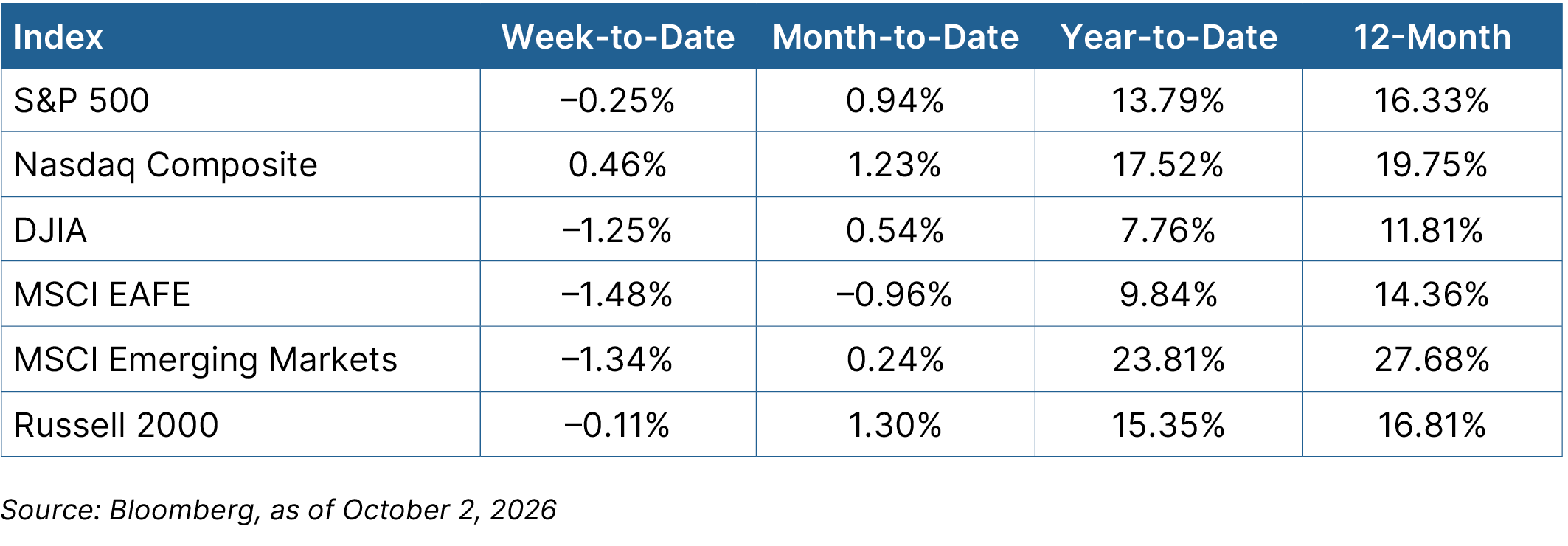
A sell-off in AI-related technology stocks caused the Nasdaq Composite to tumble 4.5 percent and the S&P 500 to fall roughly 2 percent. The Dow Jones Industrial Average and the Russell 2000 Index, however, closed higher. In a further sign of market breadth, the equal-weight S&P 500 outperformed the market-weighted index by more than 200 bps. Health care topped sector performance, rising almost 8 percent. Utilities and real estate each rose roughly 4 percent. Communication services and technology were laggards, down approximately 6 percent and 5 percent, respectively. International markets closed lower.
Source: Bloomberg, as of June 26,2026
Fixed Income
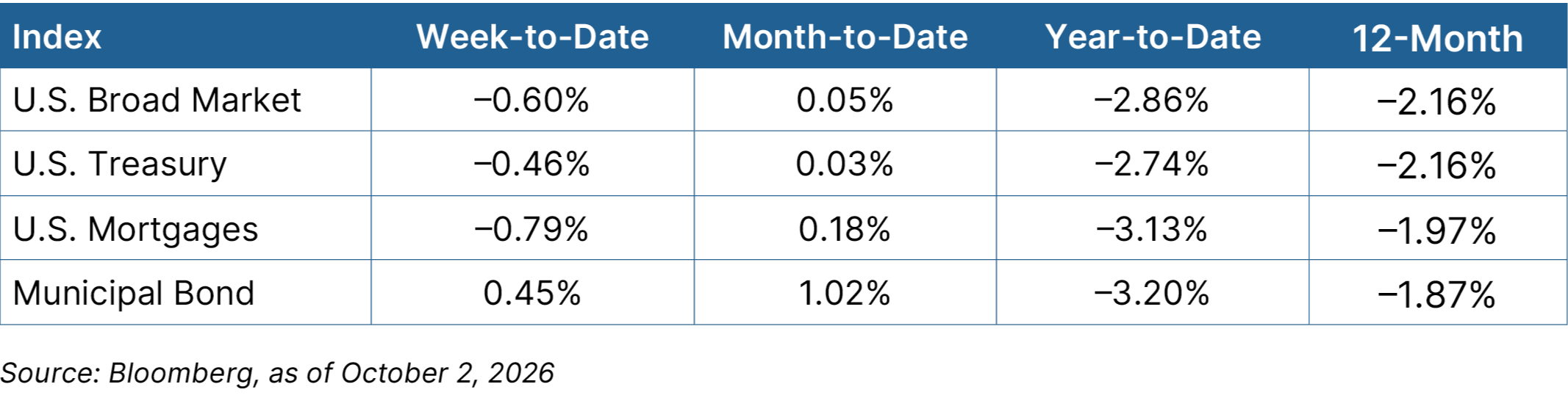
Bond markets were higher, with the Treasury yield curve flattening. The 10-year Treasury yield declined 8 bps to 4.37 percent. Core bonds were up 0.5 percent, and the municipal market posted a small gain.
Source: Bloomberg, as of June 26,2026
The Takeaway
- A sell-off in AI-related stocks led to a mixed week for global equities. The Nasdaq dropped more than 4 percent, but the Russell 2000 rallied 1 percent.
- Fixed income markets rallied as the 10-year Treasury yield dropped 8 bps.
Looking Ahead
All eyes will be on the June employment report, due to be released Thursday. It’s expected to show 130,000 new jobs, which would represent a fourth consecutive month of growth.
- The week kicks off on Tuesday with the Conference Board Consumer Confidence Index for June. Because of the recent drop in oil prices after the signing of the memorandum of understanding between the U.S. and Iran, confidence is expected to rebound.
- On Wednesday, we’ll see the Institute for Supply Management (ISM) Manufacturing index for June. Manufacturing confidence is expected to fall slightly from the May reading.
- Finally, on Thursday, we’ll receive the employment report for June. Economists expect the report to show a solid 130,000 new jobs.
Disclosure: This material is intended for informational/educational purposes only and should not be construed as investment advice, a solicitation, or a recommendation to buy or sell any security or investment product. Diversification does not assure a profit or protect against loss in declining markets, and diversification cannot guarantee that any objective or goal will be achieved. Please contact your financial professional for more information specific to your situation.
Bonds are subject to availability and market conditions; some have call features that may affect income. Bond prices and yields are inversely related: when the price goes up, the yield goes down, and vice versa. Market risk is a consideration if sold or redeemed prior to maturity.
Certain sections of this commentary contain forward-looking statements that are based on our reasonable expectations, estimates, projections, and assumptions. Forward-looking statements are not guarantees of future performance and involve certain risks and uncertainties, which are difficult to predict. All indices are unmanaged and are not available for direct investment by the public. Past performance is not indicative of future results. The S&P 500 is based on the average performance of the 500 industrial stocks monitored by Standard & Poor’s. The Nasdaq Composite Index measures the performance of all issues listed in the Nasdaq Stock Market, except for rights, warrants, units, and convertible debentures. The Dow Jones Industrial Average is computed by summing the prices of the stocks of 30 large companies and then dividing that total by an adjusted value, one which has been adjusted over the years to account for the effects of stock splits on the prices of the 30 companies. Dividends are reinvested to reflect the actual performance of the underlying securities. The MSCI EAFE Index is a float-adjusted market capitalization index designed to measure developed market equity performance, excluding the U.S. and Canada. The MSCI Emerging Markets Index is a market capitalization-weighted index composed of companies representative of the market structure of 26 emerging market countries in Europe, Latin America, and the Pacific Basin. The Russell 2000® Index measures the performance of the 2,000 smallest companies in the Russell 3000® Index. The Bloomberg US Aggregate Bond Index is an unmanaged market value-weighted performance benchmark for investment-grade fixed-rate debt issues, including government, corporate, asset-backed, and mortgage-backed securities with maturities of at least one year. The U.S. Treasury Index is based on the auctions of U.S. Treasury bills, or on the U.S. Treasury’s daily yield curve. The Bloomberg US Mortgage Backed Securities (MBS) Index is an unmanaged market value-weighted index of 15- and 30-year fixed-rate securities backed by mortgage pools of the Government National Mortgage Association (GNMA), Federal National Mortgage Association (Fannie Mae), and the Federal Home Loan Mortgage Corporation (FHLMC), and balloon mortgages with fixed-rate coupons. The Bloomberg US Municipal Index includes investment-grade, tax-exempt, and fixed-rate bonds with long-term maturities (greater than 2 years) selected from issues larger than $50 million. One basis point is equal to 1/100th of 1 percent, or 0.01 percent.
Authored by the Investment Research team at Commonwealth Financial Network®.
© 2026 Commonwealth Financial Network®
Let’s Talk About Your Financial Future
Whether you’re navigating a volatile market or preparing for the future, we’re here to help.